

Gutter Sizing

5-Inch vs 6-Inch Seamless Gutters in Metro Atlanta

Both sizes are rolled on site and carry the same 20-year labor guarantee. The difference is how much water they move — and on an Atlanta roofline, that is usually the whole decision.

What's the difference between 5-inch and 6-inch gutters?

Capacity, not appearance

The number is the width of the opening at the roof edge. A 5-inch K-style gutter gives you about 7.6 square inches of channel; a 6-inch about 11.1 — roughly 45 percent more.

In a hard Georgia downpour — four inches an hour at the peak — every 1,000 square feet of roof sends about 40 gallons a minute into the gutter. A 5-inch run carries that until a steep pitch or long valley concentrates it.

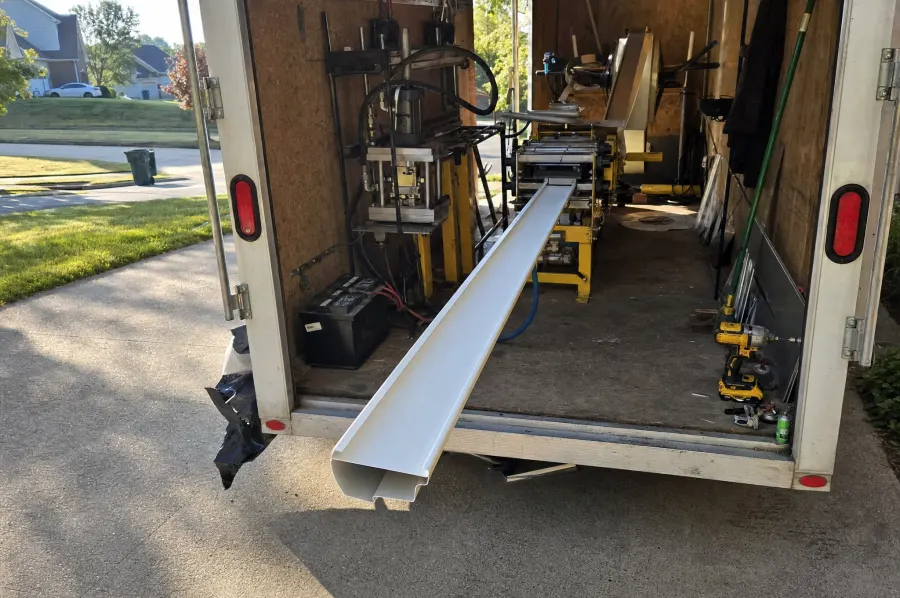
Both sizes are formed on site, each run rolled to fit the wall it hangs on — one continuous piece, not sections lapped every 10 feet.

See our gutter installation service if you want the full installation process, materials, and what a complete system includes.

— Sizing your roof —

Which size does my roof need?

There is no single answer that fits every house, because the gutter is not sized to the house — it is sized to the water. These are the four things we measure before recommending a size, and any of them alone can push a home to 6-inch.

Roof area feeding each run

The rule of thumb we start from: a 5-inch run with a 2×3 downspout comfortably drains somewhere around 1,000 to 1,200 square feet of roof. A 6-inch run with a 3×4 carries roughly half again as much — call it 1,500 to 1,800 square feet. The downspout drains twice as fast, but the channel itself only gains about 45 percent, and the channel is what sets the ceiling. Large, uninterrupted roof planes are the most common reason a home needs the bigger size.

Roof pitch

A steep roof does not collect more rain, but it delivers what it collects much faster and with real momentum. Water coming off a 10/12 pitch tends to overshoot a 5-inch gutter entirely in heavy rain. The steeper the roof, the stronger the case for 6-inch.

Valleys and roof planes

A valley funnels two roof planes into one narrow point, so a small stretch of gutter can end up carrying water from a very large area. Homes with complex, cut-up rooflines often need 6-inch on a few specific runs even when 5-inch is fine everywhere else.

Tree cover and debris

Metro Atlanta is heavily wooded, and a gutter that is partly full of pine straw is no longer the size printed on the box. A wider channel keeps carrying water with debris in it, which is why 6-inch pairs so well with guards under oaks and pines.

Why Atlanta rain settles most of these decisions

Metro Atlanta takes about 50 inches of rain a year, and much of it arrives in short, intense summer bursts rather than steady drizzle. Gutters here are not sized for the average storm — they are sized for the worst afternoon in July. That is why we recommend 6-inch on most homes we quote, and why we will still tell you plainly when 5-inch is the right call.

~45%
more capacity, 6-inch vs 5-inch
downspout area, 3×4 vs 2×3
620 gal
per inch of rain, per 1,000 sq ft
~50 in
of rain a year in Metro Atlanta

Transparent Pricing

What do 5-inch and 6-inch gutters cost per foot?

$4 – $12 per linear foot, seamless aluminum installed

Stepping up from 5-inch to 6-inch aluminum typically adds $2 to $3 per linear foot. On a standard home that is the difference between roughly $1,500–$2,600 for a complete 5-inch system and $2,000–$3,200 for 6-inch — a few hundred dollars on a system that should last decades. Copper runs several times either figure.

Installed price per linear foot, by size and material

  • 5-inch copper $15 – $28
  • 6-inch copper $20 – $35

What moves your number inside these ranges

Whole-house totals
Most Metro Atlanta homes need between 150 and 250 linear feet of gutter. A 5-inch aluminum system usually lands between $1,500 and $2,600 installed; 6-inch usually runs $2,000 to $3,200, depending on roofline length and complexity. Those totals are for the finished system — downspouts, elbows, and miters included — so they run higher than the per-foot gutter rate multiplied out.
Downspouts and fittings
Downspout count, elbows, miter cuts, and the run length back to a safe discharge point are quoted with the gutter rather than tacked on afterward. Homes with more corners need more miters, and miters take time.
Height and access
Three-story elevations and steep or hard-to-reach rooflines carry a height premium, because they need different equipment and more crew time to do safely.
Colors and materials
Color is matched to your existing trim at no premium — white, black, bronze, and Royal Brown are the ones we hang most often, with the full manufacturer range available. Copper is quoted per project.

About these ranges

These are real installed price ranges for Metro Atlanta, not teaser rates. Your exact number depends on linear footage, roof height, downspout count, and roofline complexity — which is why we measure on site before quoting.

The other half of the system

Downspout sizing (2x3 vs 3x4) and why it matters

What size downspout comes with a 5-inch gutter?

A 5-inch gutter is normally paired with a 2×3 downspout, and a 6-inch gutter with a 3×4. The jump matters more than it sounds: a 2×3 gives you 6 square inches to drain through and a 3×4 gives you 12, so the larger downspout moves about twice the water. Whatever the gutter can carry, the downspout is the bottleneck that decides how fast it actually leaves.

When do you need 3×4 downspouts?

Any time a single run is collecting water from a large or steep roof area, and always where a valley concentrates two roof planes into one outlet. We also default to 3×4 on homes under heavy tree cover, because the wider opening is far less likely to jam with pine straw and shingle grit — which is what turns a working downspout into a standpipe.

How many downspouts does a house need?

Count outlets, not sides. As a general rule you want a downspout roughly every 30 to 40 feet of gutter run, with more where the roof concentrates water at a corner. Adding an outlet is usually cheaper than upsizing an entire run, so on some homes the right fix is another downspout rather than bigger gutters.

Can you put 3×4 downspouts on 5-inch gutters?

Yes, and it is a genuinely useful middle option. If your roof is only slightly over what 5-inch handles, keeping the 5-inch profile and upsizing the outlets often solves the overflow for less than a full 6-inch system. We will tell you when that is the honest answer for your home rather than selling the larger gutter.

Do gutter guards change the size I need?

They change the argument for width. Guards keep bulk debris out, but any screen or mesh slightly slows how quickly water enters the gutter. On a steep roof with guards, the extra capacity of a 6-inch channel gives that water somewhere to go instead of running past the opening.

Cities we install 5" and 6" seamless gutters in

Both sizes are rolled on site, so the forming machine comes to your driveway wherever you are in Metro Atlanta. These are the communities we are asked about sizing in most often — each one has its own page with local work and reviews.

View All Service Areas

Get a Free Sizing Recommendation

Fast, no-obligation sizing visits — we measure your roofline and quote both sizes.

Get a Free Quote